
Table of Contents
Introduction
Walk through any modern factory floor and look at the metal parts around you. The machine guards, electrical panels, racks, and fabricated frames almost all wear a smooth, durable finish that looks far tougher than ordinary paint. In most cases, that finish began its life as a fine, dry powder. Powder coating powder is the raw material behind one of the most widely used finishing technologies in the world today, and understanding its different types can change how you think about protecting metal surfaces.
If you are exploring surface finishing options for the first time, this guide walks you through what these powders actually are, the main categories available, and the industries where each type performs best without needing an engineering degree to follow along.
What Is Powder Coating Powder?
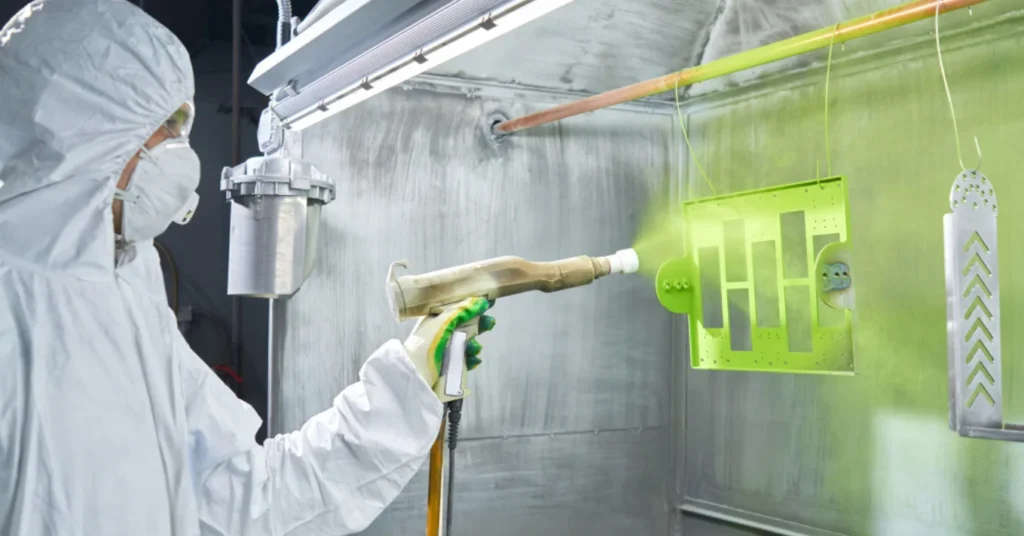
At its simplest, powder coating powder is a dry blend of finely ground resin, pigments, curing agents, and performance additives. Unlike liquid paint, it contains no solvents. The powder is applied to a metal surface using an electrostatic spray gun, which gives each particle an electrical charge so it clings to the grounded part. The coated component then moves into a curing oven, where heat melts the particles and fuses them into a continuous, hard film.
This solvent-free process is one of the reasons manufacturers across the globe have shifted away from traditional wet paint. There are no harmful VOC emissions to manage, overspray can be collected and reused, and the cured finish typically outlasts liquid alternatives by years. From a purely practical standpoint, the dry powder format also makes storage, handling, and transport far simpler for industrial users.
Having worked with fabricators and OEM manufacturers across multiple sectors, we have seen the same pattern repeat itself: once a production line switches to powder, it rarely goes back. The consistency of finish, the transfer efficiency, and the reduced environmental compliance burden make a compelling case on their own.
The Two Main Families: Thermoset and Thermoplastic
Thermoset Powders
Thermoplastic Powders
Types of Thermoset Powder Coating Powder
Epoxy Powder Coating
Epoxy is the workhorse of indoor industrial finishing. It delivers outstanding adhesion, corrosion protection, and resistance to chemicals, oils, and solvents. The one well-known limitation of epoxy is its poor UV stability prolonged sunlight exposure causes the finish to chalk and fade. For this reason, epoxy coatings are used almost exclusively on components that live indoors or underground.
You will find epoxy finishes on oil and gas pipelines, steel reinforcement bars (rebar) in construction, automotive underbody parts, electrical enclosures, and industrial machinery. Fusion-bonded epoxy, in particular, has become the global standard for protecting buried pipelines from corrosion, a testament to just how reliable this chemistry is in harsh, non-UV environments.
Polyester Powder Coating
Where epoxy struggles outdoors, polyester shines. Polyester-based powders offer excellent weather resistance, colour retention, and gloss stability under direct sunlight, making them the default choice for exterior applications. They also provide good mechanical strength and flexibility, so coated parts can handle impacts and vibration without cracking.
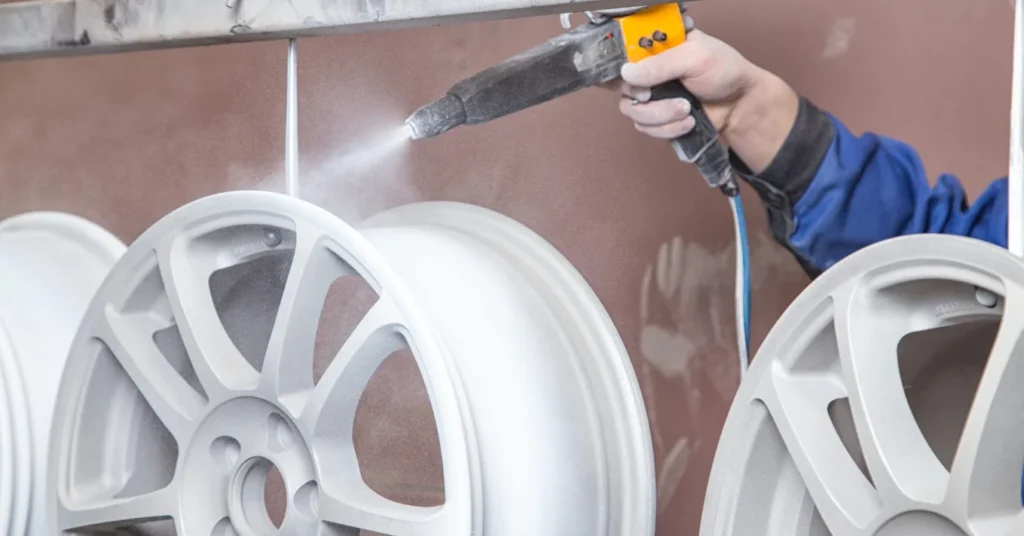
Typical uses include outdoor furniture, agricultural equipment, automotive trims and alloy wheels, air-conditioning units, light poles, and architectural facades. Super-durable polyester grades, tested to international standards such as Qualicoat Class 2, are widely specified for building exteriors that must retain their appearance for decades.
Epoxy-Polyester Hybrid
Hybrids combine epoxy and polyester resins in a single formulation, blending the strengths of both. The result is a cost-effective, easy-to-apply powder with good flow, smooth finish, and reasonable corrosion resistance. Like pure epoxy, hybrids are not suited for long-term outdoor exposure, but for interior applications they offer excellent value.
Domestic appliances are the biggest consumer of hybrid powders, think refrigerators, washing machines, microwave housings, and water heaters. Office furniture, shelving systems, radiators, and interior automotive components also rely heavily on this versatile chemistry.
Types of Thermoplastic Powder Coatings
Nylon (Polyamide)
PVC (Polyvinyl Chloride)
Polyolefin
Industry-Wise Applications at a Glance
Different sectors gravitate toward different chemistries based on their operating environments. Here is a quick reference:
- Automotive: Polyester and polyurethane for exterior parts; epoxy for underbody and engine components
- Construction and architecture: Super-durable polyester for facades; fusion-bonded epoxy for rebar and pipelines
- Home appliances: Epoxy-polyester hybrids for indoor durability and smooth aesthetics
- Agriculture and heavy machinery: Polyester and polyurethane for weather and abrasion resistance
- Medical and food equipment: Nylon and polyolefin for hygiene, wear resistance, and washdown tolerance
How to Choose the Right Powder for Your Application
Selecting the right powder coating powder comes down to a handful of practical questions. First, will the finished part live indoors or outdoors? Outdoor exposure immediately points you toward polyester or polyurethane, while indoor parts open the door to economical epoxy and hybrid options. Second, what will the coating face in service chemicals, abrasion, impact, moisture, or extreme temperatures? Each chemistry has a distinct strength profile, and matching it to real operating conditions is where experienced suppliers add genuine value.
Budget and finish expectations matter too. Hybrids deliver excellent value for interior goods, while polyurethane commands a premium for its paint-like smoothness. In our experience, the most costly mistakes happen when a low-cost indoor-grade powder gets specified for an outdoor product; the finish fails within a year, and rework costs far exceed the original savings. A short conversation with a knowledgeable manufacturer before ordering prevents exactly this kind of loss.
Conclusion
The world of powder coating powder is broader than most people expect, and each chemistry epoxy, polyester, hybrid, polyurethane, nylon, PVC, or polyolefin exists because a specific industry needed it. Choosing well means matching the powder’s strengths to your product’s real-life conditions, and that is far easier with an experienced partner guiding the decision.
At Prismcoats, we manufacture a complete range of high-performance powder coating powder for automotive, architectural, appliance, and general industrial applications. Our technical team helps you select the right chemistry, finish, and grade for your exact requirement so your products look better and last longer.
Ready to find the perfect powder for your application? Contact Prismcoats today for expert guidance and a free consultation.